
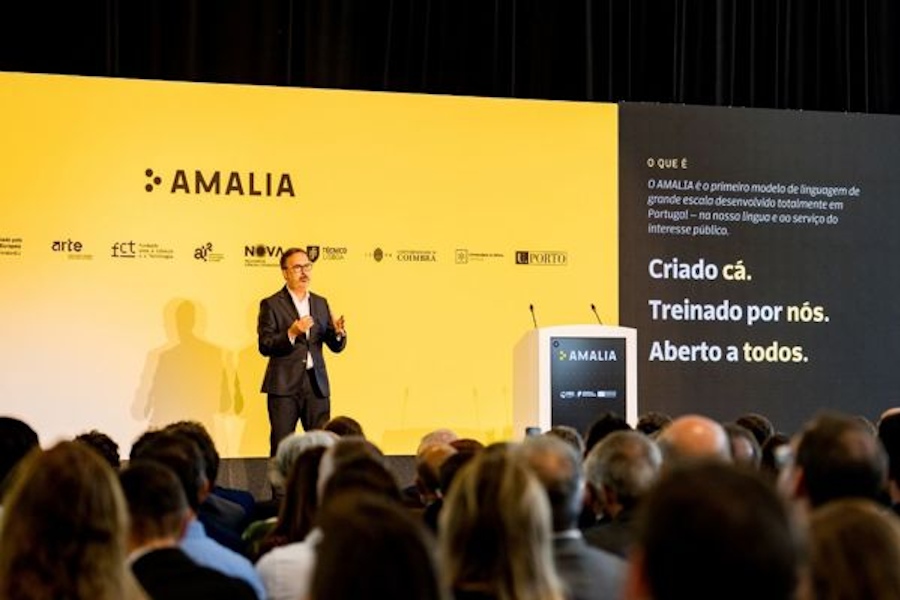
Amália, the first major language model created specifically for European Portuguese is real. Developed by Portuguese universities and research centers, Amália aims to support public services, businesses, researchers, and citizens.
Amália stands for Automatic Multimodal Language Assistant with Artificial Intelligence, and the Portuguese government describes it as a strategic investment in digital sovereignty, that is, the country’s ability to develop its own technology and reduce its dependence on foreign solutions.
Amália is, itselft, a language model. As a comparison, ChatGPT is an application created using OpenAI language models. This means it can serve as a basis for creating different tools, applications, and virtual assistants adapted to the Portuguese reality.
The project was lauched after 18 months of development by researchers from the Universidade Nova de Lisboa, Instituto Superior Técnico, Universidade de Coimbra, Universidade do Porto, Universidade do Minho and Fundação para a Ciência e Tecnologia. In total, approximately 30 specialists participated in the development of the base model, along with more than 50 researchers in specific areas.
Portuguese and European supercomputers were fundamental to train Amália, including infrastructures such as Deucalion, MareNostrum 5, and EuroHPC systems.
In its first phase, the model included nine billion parameters and was trained with billions of words in Portuguese, including data from Arquivo.pt. Amália is multimodal, which means it can work with different types of information, understanding text, speech, images, and digitized documents, and supporting tasks such as answering questions, translation, document research, and image description.
This technology was built to be used in various areas:
- In Public Administration, it should initially be integrated into the Gov.pt portal, functioning as a virtual assistant to clarify citizens’ doubts.
- In Education, applications with tools to support teachers.
- In Culture, through assistants for museums and monuments.
- In the area of sovereignty, with decision support solutions for the Navy.
Amália will be available as open source and can be downloaded from the ia.gov.br portal, which redirects to the Hugging Face platform. The Apache 2.0 license allows citizens, companies, and institutions to use, modify, and distribute the model, including in commercial projects.
Portugal invested €5.5 million, through the Recovery and Resilience Plan. A new development phase is also planned, worth €1.5 million, which should allow the model to evolve to 22 billion parameters and add new capabilities by 2027.
The model underwent robustness tests, data filtering, and risk mitigation mechanisms to reduce incorrect, discriminatory, or dangerous responses. Yet, despite security guarantees, like any artificial intelligence system, Amália can make mistakes.


