
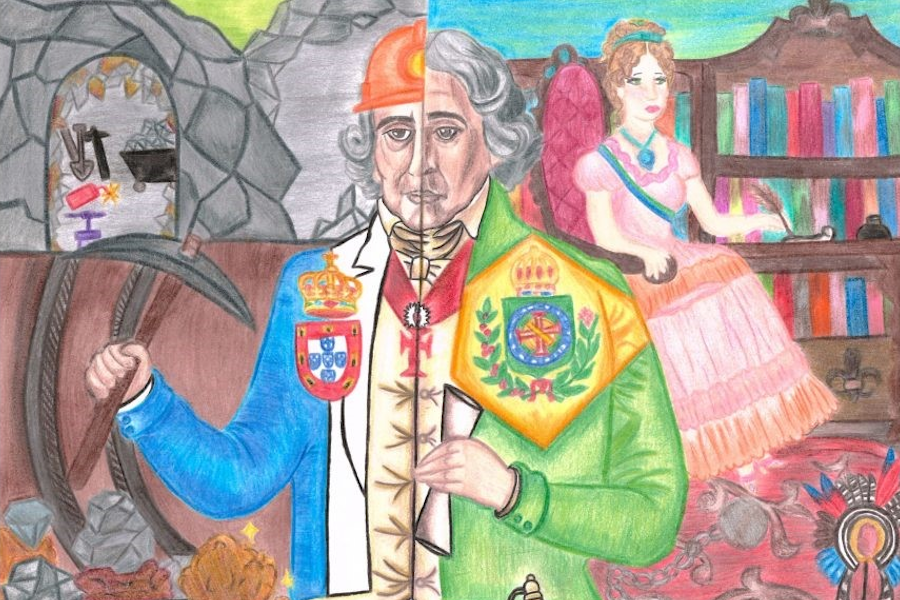
During a visit to the Rectorate of the University of Coimbra, I received a copy of the book José Bonifácio de Andrada e Silva e a inauguração da cátedra com o seu nome na Faculdade de Direito de Coimbra (José Bonifácio de Andrada e Silva and the inauguration of the chair that bears his name at the Faculty of Law of Coimbra).
Andrada e Silva is an important point of connection between Portugal and Brazil, but also an icon when we consider the very current concept of ESG (Environmental, Social, and Governance).
The trajectory of the man best known as the “Patriarch of Brazil” is vast, but for the purpose of this text, we will focus on particular points.
E
Also called the “Patriarch of Ecology” (according to some online sources), Andrada e Silva studied natural history, chemistry, and mineralogy at the University of Coimbra. In addition to his academic career, he held public office, including that of Superintendent of Reforestation Works of the Coastal Sands.
It was Andrada e Silva who published, in 1815, a fundamental technical treatise called Memória sobre a necessidade e utilidade do plantio de novos bosques em Portugal” (“Memoir on the necessity and usefulness of planting new forests in Portugal”). The work addressed in detail scientific methods to contain the advance of dunes through tree planting, in addition to criticizing forest destruction without subsequent replanting.
In Brazil, where he was born, he created the Brazilian ecological policy. He warned about predatory agriculture and burning and how they would transform Brazil’s fertile territory into “arid deserts.” He was a proponent of environmental protection laws, the end of wood waste in the naval industry, and the mandatory reforestation of cultivated lands.
S
Bonifácio was a researcher and a curious individual eager for social progress. For a decade he traveled through Europe, visiting France, Italy, Sweden, Denmark, Belgium, Holland, Hungary, and England, also witnessing both Industrial Revolution and French Revolution.
His vision was controversial and caused discord within the court of Pedro I, leading to his persecution by various political leaders. One of his proposals for a strong and sustainable nation was the end of slavery.
G
Andrada e Silva was directly involved in the arrival of British Admiral Cochrane. And Cochrane was decisive in the creation of the Brazilian Navy. Because of this, the Navy was fundamental in maintaining control of the states in the North and Northeast.
Brazil’s independence is linked to a letter from Bonifácio to the Prince Regent, in which Bonifácio advised Dom Pedro to remain in Brazilian territory, recommending that he should not return to Portugal.
Bonifácio Andrada e Silva was appointed to the Ministry of Foreign Affairs and, in this role, recommended the construction of a capital in the interior, which was strategic for strengthening national integration.
We are talking about a historical figure who lived in the 18th and 19th centuries, yet he was already trying to put into practice the principles that are now associated with the SDGs and ESG policies. Perhaps this is a good demonstration of the resistance that such measures have encountered throughout world history.


